Showing posts with label Palenque. Show all posts

Friday, November 27, 2009

Alberto Ruz, Palenque and Nelson Rockefeller

In at least two of the INAH Anales reports regarding Palenque, Alberto Ruz thanked Nelson Rockefeller for the funding he contributed to the excavation projects at the site. When I read this statement, it sparked my curiosity, so I contacted the Rockefeller Foundation archives to see what I could discover about it. They sent me copies of several pieces of correspondence (1947- 1958) between Ruz, Rockefeller and the members of the Institute of Andean Research. This institute was the organization through which Rockefeller funneled the money - apparently for political reasons. Above is a picture of Rockefeller on the cover of Life magazine when Life did a story on the Museum of Primitive Art.

Above is a picture of Alberto Ruz. One of the stipulations regarding the receipt of the Rockefeller funds was that they were to go hand-in-hand with the money that the Mexican government was putting into the project. In 1955, Rockefeller requested a summary of all the funds contributed by INAH as compared to his. According to Ruz' accounting, between 1947 and 1955, Rockefeller had contributed 40% of the entire budget for the project, with INAH putting in 60%. From the tone of the correspondence between these two great men, it is possible to see that they were very warm friends. Time and time again, Ruz invited the Rockefellers to Palenque and finally they did make one visit. Ruz wrote in 1956 "My wife and I have the fondest remembrances of yours and Mrs. Rockefeller's brief stay among us." He was referencing Rockefeller's first wife, Mary Todhunter Clark, who also would eventually contribute money to the project.

Nelson Rockefeller and Mary Todhunter Clark Rockefeller

Sunday, August 16, 2009

Palenque's Greatest Story Teller

My sweetheart David came to Palenque to take me home after the accident, but before we left, we spent some time reminiscing with Don Moises Morales. In case you don't know him, I should give you some background. David and Linda Schele met Moises Morales 39 years ago during their very first visit to Palenque. Gillette Griffin (1991) writes that Moises was “that very special man who had shared the magic of Palenque with thousands of pilgrims over the years. Moises took the Scheles and their party for a walk deep into the jungle. He showed them the beautiful cascades that splash down into stone basins under the dense jungle canopy, and revealed to them the presence of ruined walls and buildings everywhere.” Another well-known Palenque scholar, Merle Green Robertson identifies Don Moises Morales as "the greatest 'storyteller' in all Palenque.

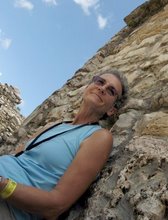
The picture above was taken just after David and I finished having lunch at El Panchan http://elpanchan.com/alojamiento_eng.htm. It's a very fine restaurant that sits adjacent to the ancient site of Palenque, but is within the Morales family compound. You can see that my cast is gone and is replaced by a brace, since the broken wrist isn't healed yet.

Tuesday, April 28, 2009

SAA Slides, GIScience and Temple of the Cross

Hello friends. The FTP site where I had previously stored several of the links in my last post is no longer working, so I have uploaded my files to another Internet location (Google Docs) and I have now updated my previous blog posting as can be seen below.

Here is the slide presentation that I created for the 2009 Society of American Archaeologists Conference in Atlanta:


Here is the new link to the Palenque Flyover:

Tuesday, March 31, 2009

Clarification on the Term "Incensario"

I just realized that some of my readers might not have know what I was referring to in my previous post when I wrote the term Palenque "incensario".  The image above is an example of an incensario that was found in the terraces of the Temple of the Cross. In reality, these large ceramic artifacts are believed to be the stands that went on top of the incensario (Spanish word for censor).  The censors and their associated stands were used by ancient Palencanos to burn incense for the veneration of their 3 major gods.
 
Above is an image of a North American totum pole.  The man standing beside the pole is unidentified in the book from which I scanned this photo (Nabokov and Easton 1989).  The reason that I include a picture of a totum pole here is because Miguel Angel Fernandez, an archaeologist who excavated at Palenque in the 1940's was one of the first to notice the resemblance of the incensarios to North American totum poles.  According to Alfonso Morales, one of the more recent archaeologist who has worked at Palenque, the earliest term used to describe the "porta-incensarios" was "cilindro".

Saturday, March 14, 2009

What a Mess

One of the most important things that I must do in order to move forward with my dissertation research is to establish artifact typologies and classifications. I have spent the last two weeks working on these classifications and I think that I have finally made some progress. Above is a photo of only a few of the lists and categories that I have created, deleted and edited.


This painful and confusing process has helped me decide upon what feature datasets and feature classes I should create in ArcGIS and what corresponding Excel spreadsheets that I should formulate so that I can link the spreadsheets into the map. Above is a screenshot of ArcCatalog where you can see some of my categories. By entering artifact numbers into the appropriate feature class category and then placing that same artifact number in the Excel spreadsheet containing data about that artifact, I will be able to link the map with the data in a simple manner that even novice GIS users can replicate. One of my research goals is to try to figure out how to encourage Mesoamerican archaeologists to use GIS applications and I think that this linking method will help.

Thursday, December 18, 2008

Caches of the Temple of the Cross


You may remember the above map as a smaller portion of a map that I posted in an earlier entry (it was annotated by Linda Schele) when I was discussing archaeologists that have excavated at Palenque. The map does not display those made by Miguel Angel Fernandez in the early 1940s where he found several caches in the Temple of the Cross and Sun.

Temple of the Cross

Temple of the Sun

The underground caching of objects by the ancient Maya people was a frequent ritual behavior and is evidenced in the archaeological record throughout the Maya Area, particularly within sacred temples. These caches often take the form of buried and covered pots that contain a variety of objects including things such as human bones, charred flowers, figurines and obsidian lances.

Photo Credit: Archaeologia Mexicana and Marco Antonio Pacheco/Raices

The pot on the left above was found in the Temple of the Cross by the Fernandez in 1941. When there are multiple caches in one building, the configuration of how they are laid out can have ritual or symbolic meaning. For instance, many are found in the shape of a cross or in the shape of a quincunx (one in each corner of the building and then one in the middle).


But the grouped cache excavated by Fernandez shown in the diagram above was of a very strange configuration that he postulated was in the shape of the big and little dipper (he also thought that it could be a coincidence). The layout does not quite fit these two constellations and the ancient Maya would surely have made it more precise, if that was their intention. What do you think it might represent or is this just a random "building ensoulment".

Here is a picture of some of the holes in the floor of the building. It was hard to take this photo, since I had to try to fit my camera through the screening device protecting the sanctuary. You may ask “how did Fernandez know where to dig for these caches?” He knew where they were because he could see the holes in the stucco of the floor where they had been patched up.

Tuesday, September 2, 2008

Fuzzy Boundaries

Soon after you arrive at the main entrance gate to Palenque - the one where they take your 20 pesos and ask you what country you are from - you realize that there are other landowners that encroach into the park boundaries. All the painted signs along the road going up into the site are a dead give-away. The boundary for the park was established several years ago, but there are still people who own land within it. I have been told that the government would like to purchase these properties to better protect the site and its archaeology, but they haven't come up with the funds to do this yet.
The first sign you see right at that front gate is the all popular lodging, eating, drinking and music establishment of El Panchan, along with various other businesses. Panchan has some of the best food I have ever eaten and they employ outstanding chefs.

The next establishment along the road doesn't seem to have a name, but has a sign advertising bungalows.


Then there is a youth hostel...

A place called La Palapa...


Next comes Michol Palapa - The word "Michol" is also the name of the nearby river.

Kichanes cabanas and camping

Last, but not least is the Mayabelle. Ed Barnhart and his crew actually mapped part of this property, since the land contains ancient structures.

Tuesday, August 26, 2008

After 5 Thousand Years

I recently received a new National Geographic magazine collector's item publication in the mail.
As I was flipping through the softbound book, I noticed the messages contained on the inside of the front cover.
And then I noticed the inside of the back cover. Delfino Lopez Hidalgo, one of the administrators at the Palenque site from the INAH (the Instituto Nacional de Antropología e Historia) told me that the governor of Chiapas, as well a the National Secretary of Tourism had spent large amounts of money in tourism advertising in order to promote the state of Chiapas. Visit http://www.sectorturismo.gob.mx/wb/sectur/sect_buscador?q=chiapas
to see some of their information. Since visitation is up this year it seems to be working.

Saturday, August 16, 2008

Autobuses de Turismo

One of the most amazing things that I observed at the site are the number and variety of large tour buses, the majority of which are road worthy, air conditioned and comfortable. They usually seat about 40 to 50 people.
Here is another one that is trying to turn around in the tight parking area that is also used by the vendors, the guides, the tourists as well as other buses.
I love the ones that have the bright colors and that look like they have bug antlers. Those appendages are actually their rear view mirrors. These two buses are trying to squeeze by on the narrow two lane road that leads into the park.
Here I am sitting by the roadway counting each kind of vehicle that comes into the park (bus, car, taxi, etc.). I was a transportation planner in a previous life, so I felt very comfortable taking one hour traffic counts by mode. I did this on various days at various times throughout one week and estimated that there are an average of 4 large tour buses that come into the park every hour - during the SUMMER SEASON. If you multiply that out, it comes to an average of 50 buses each day during vacation season. Un-averaged counts would reflect that, there are more of these buses on Sundays, since Mexican nationals do not pay a park fee on Sundays and there are less buses on some of the weekdays.
There has been a increasing trend in the use of these large coaches over the years that local people have noticed. Their use impacts the local economy, sometimes in a negative way. The tour operator, knowing that he/she has promised the group that they would visit several cities and several sites in X number of days, funnels the people into a local hotel for one day and then the next, takes them up to Lakamha' (Palenque) for a few hours, puts them back into the bus and then they are on their way to the next location, without even seeing or spending their money in the little pueblo of Palenque.I placed the "tourist circuit" on a map to help you see how the people are taken by bus to the park entrance at the top of the hill and then they are lead (or self lead) through the circuit which is a distance of 1.2 miles or 1.9 kilometers downhill. They are given a set amount of time to make it through the site - to be back at the bus that is waiting either at the museum parking lot or the informal lot where it is being washed. Then they put them back into the bus and they are off again to the next destination.
And yes, some make it through the site faster than others and are happy to be able to relax after such a stimulating and very sweaty walk.

Friday, August 15, 2008

Tiendas de Portátiles

I created this map to show locations where the vendors are usually found at the site. I estimate that they use approximately 9,153 sq. meters of space in total.


With the exception of those vendors who are lucky enough to have a real booth with a roof, each person must have enough ground area to spread their goods out for display.


How's this display for an eye catching color burst?


The waterproof blue cloths that you see below the merchandise serves several purposes. They help the vendor lay out his/her territory, they offer protection for the goods as they lay on the ground, they give a nice contrast so that the goods show up well as the tourists pass and most important of all, they are used to bundle up the pretties and carry them back home.

The majority of these people do not live in the Modern City of Palenque. Most of them (and the guides also) come from a small indigenous community called El Naranjo, two miles away. I created this map to show you where this pueblo is located (sorry for the poor resolution, but my digital elevation model is the problem). There is no road to drive to the site from El Naranjo, so each day these hard working people carry their bundled good on their backs for two miles to get to their designated spot.

Here are a few of the men taking a much needed break in the shade.

Tuesday, August 12, 2008

Selling the Maya Mystique

Chances are good that many of the local people who used to work at the site wielding machates and cutting grass are now site vendors. On Friday, July 25th, I counted 79 vendors spread out on the ground at various locations within the site and this was not an unusual day.

This year, I would estimate that one third of the items being sold are painted cowhide leather works. This vendor has found an opportunity to use an ancient altar next to the palace to lay out his leather ware reproduction of Pakal the Great's sarcophagus lid and explain it in detail. Perhaps if the ancient Maya had cows back in those days, they might have gone through this same routine.
I will not speculate about the source or production of some of these modern leather "paintings" -- whether they are hand or machine made, but I know that all the works from this vendor were carved by him. I watched him expertly work several pieces from limestone.

One of the things that I find interesting is the variety of reactions by the tourists to the vendor's sales pitches. Here is a German couple heavily engaged in a transaction with a proactive and persistent Mexican vendor.
Other approaches at bargaining are more amenable. This man, being very sensitive and observant, kindly questions the indigenous Maya woman about her products and the sale goes down quite easily.

Sunday, August 10, 2008

God Bless the Grass

This picture is one from Tikal. One year ago, when I visited Palenque, I witnessed a crew of men with machetes like these, descend upon the terraces of the ballcourt and make quick work of "manicuring" the lawn (thanks again to Flickr for this photo).
However, this time I saw men with lawnmowers!!!
Although, not power driven...
As well as a man with a weedeater. Although more efficient, I wonder how many people lost their jobs due to these "upgrades".
From this map, you can see the generalized areas of garden and lawn maintenance for the park. I used the GIS to figure out the area measurements. There are approximately 2,450 sq. meters (8,038 sq.feet) of gardens to maintain and 85,878 sq. meters (281,751 sq. feet) of lawn and terraces to mow.
Not only do they mow the grass, but they rack and sweep the leaves off the tourist walkways. The leaf blower has not yet made its way this far south.