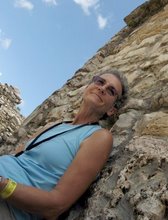
As part of my research, I am investigating the personalities of those who have worked in the Palenque Cross Group and sometimes while doing this research, I come across some very interesting tidbits about these people, their actions and reactions. Recently, while going through some of Linda Schele's letters, I came across letters from Bob Robertson, the late husband of Merle Green Robertson, (photo is from Merle's book "Never in Fear") to Linda that related a very humorous and endearing event regarding the bones of K'inich Janaab' Pakal who was ancient Palenque's most influential ruler, ruling from March 23, 603 to August 28, 683.

Pakal's bones were found in 1952 by Alberto Ruz in an elaborate tomb inside the Temple of the Inscriptions. The letters are dated October and November of 1977 and they were about how the archaeologists from Mexico City were headed to Palenque to take the bones to Mexico City, do restoration work on them, and then return them to Palenque. Here is what one of the letters said:
Last Thursday 5 individuals from INAH descended upon the Runias for the express purpose to prepare Pacal's bones so they could be taken to Mexico City.....Telegrams and phone calls to the Governor and the Pres. and no doubt INAH; meetings of the Mayor, Carlos, David, Moises and others. The school children were alerted for a strike and a peaceful march to the runias to protest. The Indians were notified and the townspeople were notified by use of a sound truck.
Ramon (who was one of the INAH anthropologists) met with the mayor and told him they were preparing the bones to stay here at Palenque and promised the skull will be brought back. Just by chance Alberto Ruz was in Villahermosa when all this was taken place. At the moment all is quite. Some of INAH folks have gone back-- the photographers. There is a committee set up and two watchers are constantly at the tomb for they are still working to see that the bones remain here. Yesterday's Sunday paper from Villahermosa had headlines—
“INAH STEALS BONES OF PRINCE” In the article, they said some "snobs and *~a* traitors call the Prince Pacal" and international stupids say he is an astronaut.
In the next letter, Bob and Merle tell Linda that none of the bones were taken out and instead the tomb had been sealed to make sure that they were secure. Even the governor of Chiapas called to make sure that the bones were not moved. To my knowledge, the bones are still in the tomb where, no doubt, they are deteriorating into dust.
 The great Mexican archaeologist, Cesar Saenz excavated at Palenque during the early 50's, under the direction of Alberto Ruz. Here you see a picture of Saenz at the site of Xochicalco where he is displaying one of its unusual stela.
 At Palenque, one of Saenz' many projects was to explore the twin temples, XVIII and XVIIIa. Within those buildings, he found 7 burials, 6 of which contained artifacts indicating that the persons buried there were royal. As you can see, the buildings are in ruin.
 Here is one of the jade pieces that was found in Tomb 2. It is displayed in the site museum. When Saenz described it, he wrote that this was an image of "halach huinic" in a seated position and Ruz describes it simply as a figure between two snakes (note the creatures on either side of the man's head). This iconographic image is the same one found throughout the Classic Maya region, so it has been studied by Mayanists again and again. More recently, many scholars have interpreted this figure as that of the maize god. I had not seen this image as labeled "halach huinic" previously, so I went to the Google Books website to try to find books where this word is used and in what context. I found several books that interpret it as meaning as in Spanish as "hombre verdadero" or "true man" (JES Thompson 1975; Ferrero 2002; Gonzalez 1998). Somehow I think that the word has lost something in the translation.


 Posts
Posts